

I’ve got a Google Alert set up for my name, to keep up to date on where references to me or my work might pop up. This weekend, I got an alert from an unlikely place: LADBible.
“Man explains key difference between being 'graysexual' and a low libido” (which was off to an annoying start by completely ignoring I’m agender), snagged an Ace Dad Advice video from the early years of the project in which I parse some of the differences between graysexuality and having a low libido. It’s pretty standard low-effort stuff — it just recaps my explanation and calls it a day.
While I think it’s funny to show up on LADBible, I was also curious as to why they’d be digging up this video from a few years ago. I did a little Google sleuthing and found this piece from The Tab: More and more people are identifying with greysexuality, but what does it actually mean? The New York Post is also getting in on the graysexuality action, although with typical Post snark, calling it a “Gen Z obsession.”
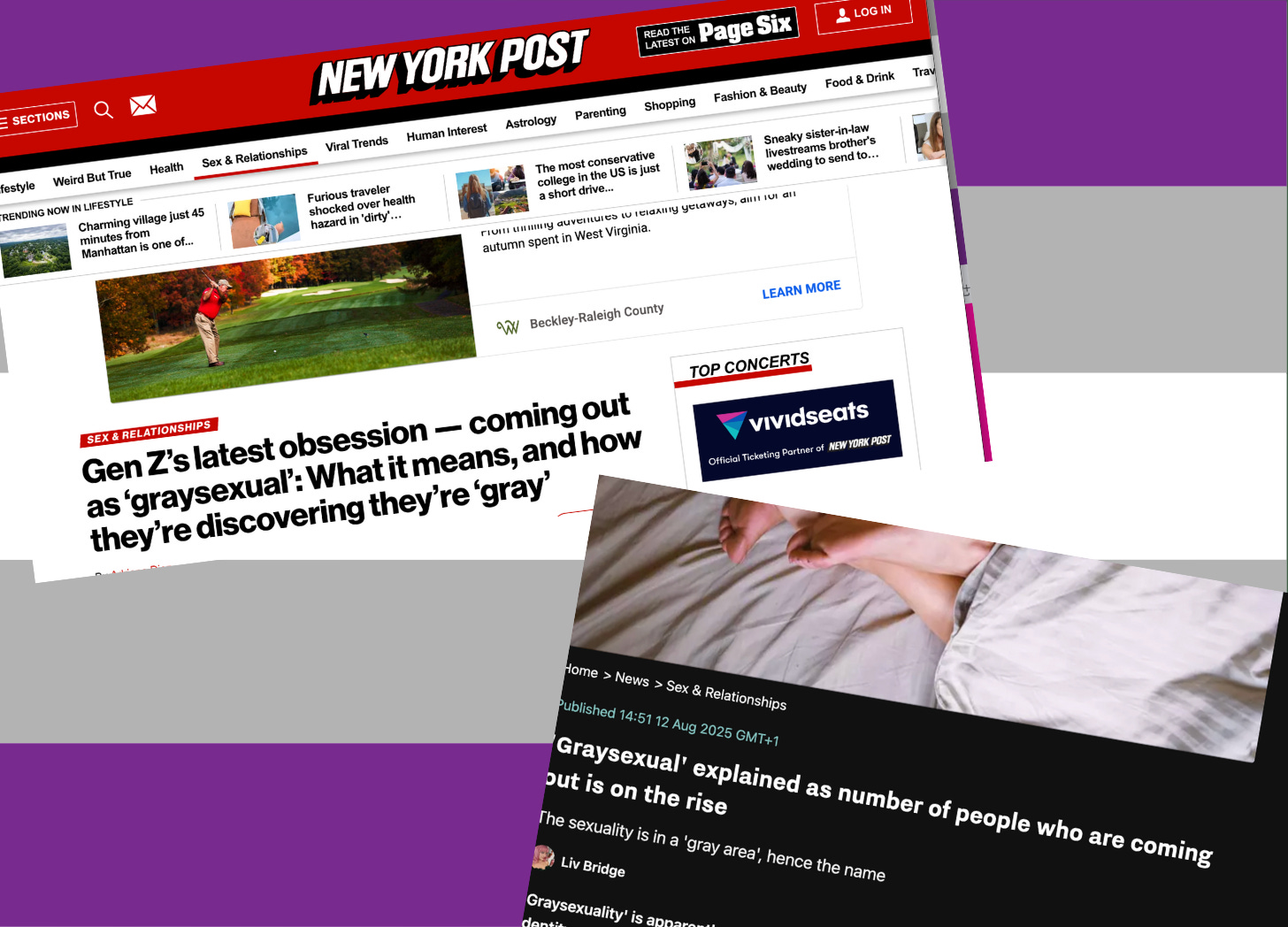
I generally side eye these kinds of articles about aspec community. They’re often written by folks outside the community, which can lead to mistakes, misunderstandings and underresearched assertions. They also tend to frame aspec lives as a freak show — “Hey! Look at these weirdoes not being allo!” — or dress up their clickbait in a voyeuristic sympathy. They’re designed to farm engagement and “conversation,” although often they’re little more than perpetuations of stereotypes we work hard to overcome.
Nevertheless, graysexuality is having a moment. But, as is often the case when something queer becomes the new shiny thing for the non-queer culture, visibility is a mixed bag.
The Good
It’s good that people are talking about graysexuality, because it helps allo folks know we exist. Sure, it’s not a national conversation on par with the Epstein Files, but any broad recognition of the existence of ace microlabels by people outside our community is important. The invisibility of aspec realities are often a central hurdle for aspec folks in their interpersonal relationships. So discussions of our language and how it describes our experiences (even when the details aren’t always quite correct or complete) helps to counteract our broader invisibility. While these articles can be cringy in the way a lot of online “Did you hear about…?” content can be, it’s likely these articles are the first point of contact for a large number of readers. That exposure, despite the quality, has value.
It’s good that it might be the spark of someone’s aspec awakening. Allo folks aren’t the only ones who benefit from our inclusion in spaces like these. These articles could also be the first point of contact for someone who needs to find this language. It’s important to remember that invisibility doesn’t just harm folks who already know they’re aspec. It also hurts folks who’ve yet to figure it out. Articles like these, clickbait though they might be, could be someone’s spark of recognition.
The Bad
They perpetuate queerphobic and aphobic tropes. Underresearched articles written by non-aspec writers are a fertile breeding ground for queerphobic and aphobic tropes to sneak into the narrative. Exoticizing the experience or identity, framing it as a trend or a fad, positioning it as something worthy of sympathy, and, in the particular case of asexuality or aromanticism, focusing solely on the range of experience closest to allonormative experience as the ideal are all ways these articles articulate more harm than good. And sometimes the sneaking in of harm isn’t even sneaking. Outlets like the New York Post will blatantly insert their own Culture Wars motives (“The Woke Left is Indoctrinating the Kids With Queer!”) and use a subcommunity like the graysexual community as a pawn in their broader attack on queer people. This is why it’s so crucial to let aspec people tell our own stories and explain our own lives.
Our labels can lose their aspec context. When the story of aspec experience and the language we use to tell that story is delivered to an allo audience by allo middlemen, allo-relatable parts of the language can get used by allo folks without maintaining their aspec origins. The Lab article made a point to differentiate graysexuality from asexuality and demisexuality, without making the point that they’re all part of the same spectrum. These pieces also fail to fully connect “graysexual” as language invented by ace people to describe an ace experience. A similar thing happened when “demisexuality” had its “moment.” Allo people, relating to certain components of the experience as described in these pieces, adopted it as language to describe them, without honoring the label’s ace origins. I even encountered people who proudly claimed to be demisexual but were offended by the suggestion they were ace. It’s a frustrating act of appropriation, because aspec microlabels are part of the aspec community’s culture of writing us into the narrative of human sexuality and relationships, in language we don’t have to wear uncomfortably.

I had friends who started identifying as demisexual but were uncomfortable with being considered aspec. They also had no interest in participating in or supporting the broader asexual community. And they were confused why that upset me a little. I was glad that my being out, open, and willing to discuss my being aspec led to them understanding themselves better, but their (likely unintentionally) aphobic attitudes were a bit of a kick in the teeth. Still, they were willing to listen and grow, so that helps. But not everyone is like that.
Gosh, I hate when articles from right-wing rags like New York Post try talking about asexuality, because they never will try to actually talk to us or listen to us. They just take it from a derisive angle, because we don't reinforce their worldview that everyone wants sex all the time.
Reminder: Page Six, which is literally a bunch of celebrity gossip that's no better than TMZ, is run by the New York Post.
The Alexander Hamilton newspaper with nonstop bullcrap.