

In the first third of Together, the new film written and directed by Michael Shanks and starring Alison Brie and Dave Franco, we’re treated to a recounting of a famous bit of Plato’s Symposium: the origins of love. In Plato’s telling, humans used to be two instead of one, bound together with our other half, living our lives in perfect harmony. Their happiness angered the gods, so Zeus ripped each apart apart with lightning, and scattered the separated halves across the known world. That’s why now, Plato says, we search for our other half, our missing piece. That’s why love came to be — to find the one who completes us.
Shank’s film takes that ancient bit of mythmaking — and every cultural norm that’s come with it in the centuries since — to its most extreme and horrific ends, making Together a blistering, exact examination of some of the deepest ace and aro anxieties.
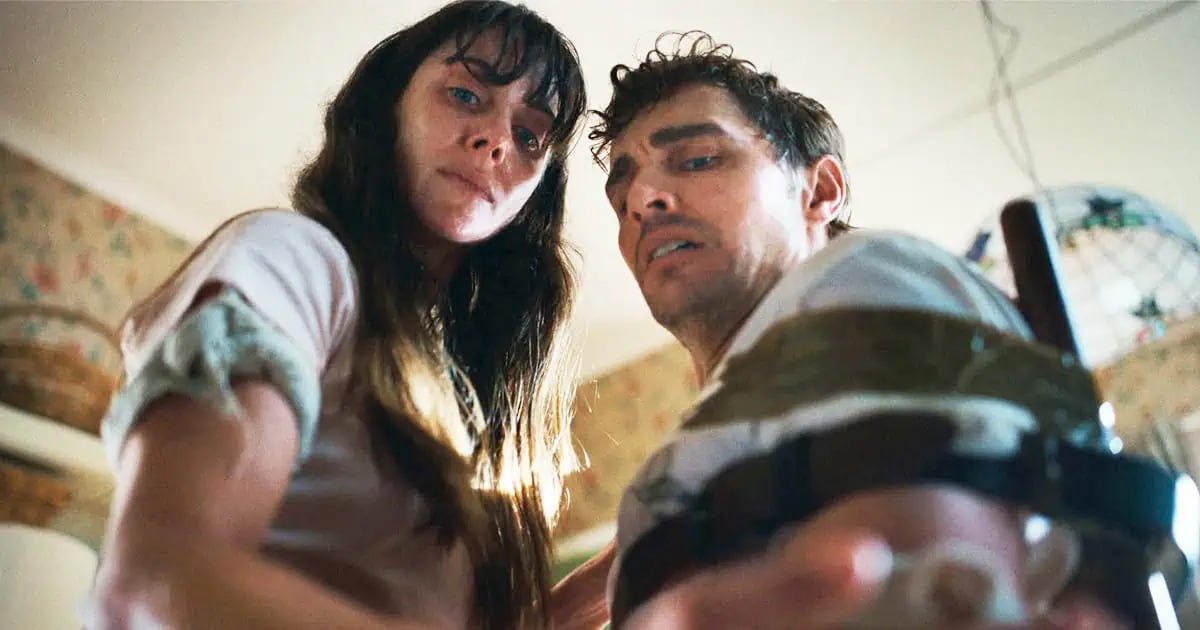
The film follows Millie and Tim (Brie and Franco), as they move from the city to a small town in the woods. They’re chasing a teaching opportunity for MIllie, forcing Tim to leave behind some of his pursuit of becoming a “rock star.” At their going-away party, Millie proposes (a small upended film trope I appreciated), and with some hesitation, Tim accepts. It’s one of several moments in the film’s opening scenes were we see the tensions at play in their relationship, small cracks that we know will let the darkness in. It’s a horror movie, after all.
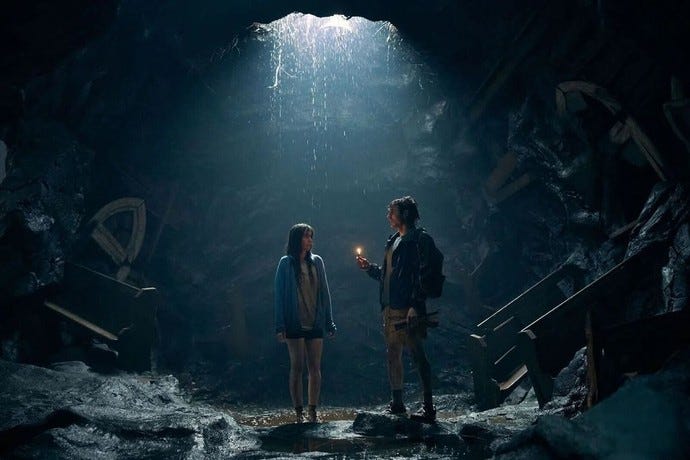
On a hike in the woods around their house, an unexpected rainstorm and a well-hidden hole in the earth land Millie and Tim in a cave with some out-of-place churchlike interiors and a creepy pool of water that looks like something out of the crashed ship in Ridley Scott’s Alien. What happens in that cave sets the bulk of the film in motion: a constantly escalating, spare-no-horror ride as Millie and Tim find they are more drawn to each other than ever.
That’s a coy bit of understatement, but the delights of this film won’t be spoiled by me.
Through an aspec lens, Together is a critique of the lies we tell each other about the supremacy of sexual and romantic love (particularly the monogamous, heterosexual kind). We all know them: “You have to find ‘The One!’” “There’s someone out there to complete you!” “You’ll find someone who you desire singly and above all others!” While we hold those up as romantic ideals, Together sees them as nightmare fuel, and the film graphically, with full blood-and-bones panache, plays those ideals out to their inevitable ends. It depicts what aromantic folks already know to be true; amatonormative ideals are, for many of us, unattainable and unlivable. But we’re damned if we do and damned if we don’t. If we don’t chase romantic love, we’re somehow subhuman. If we do, we subsume and repress who we really are. It’s dehumanizing either way.
While the bulk of the film’s critique is aimed at relationships and relationship expectations, its choice to use body horror as the vehicle highlights anxieties felt by asexuals. At play here is the idea that, as long as you find “The One,” sex will be something wonderful, enjoyable, and joyful. “The One” solves everything – even one’s asexuality. Finding the perfect partner is the key to sexual attraction, and desire springs up like a wellhead when you do. In Together, sex is a menace, the force pulling Millie and Tim together as they wind their way through the story. They’re each other’s person, and their desire for each other burns, but it also comes with their slow destruction. They take the notion of “losing yourself in desire” literally, and throughout the film sex is paired with some horror enacted on the body. Desire and want are turned monstrous. It’s a nice subversion of the allonormative idea that sexual desire is simply “being human,” and pierces with precision the myth that finding “The One” unlocks the magic and mystery of sex.
While it’s not the film’s intent to be a war cry for ace and aro people against the normative Big Baddies that diminish, pathologize and dehumanize us every day, Together paints those norms as consuming cancers on being an individual. We are constantly pushed to tie our lives and our selves up with one other person who “finishes our sentence,” but Together condemns that as essentially an act of self-destruction.
Here, being “joined forever” is a disappearing act, one that erases not just the soul, but the body.
I left Together thinking, “This is exactly what so many ace and aro people are afraid of.” Being rendered invisible to themselves and the world by cultural norms that hide their monstrosity well.
just watched the movie after seeing your post. i love your perspective on this. as an arospec, i love how the movie shows a different idea of intimacy.
well damn.
I had seen a poster, but I didn't even pay any mind.
Gonna have to watch it now.